
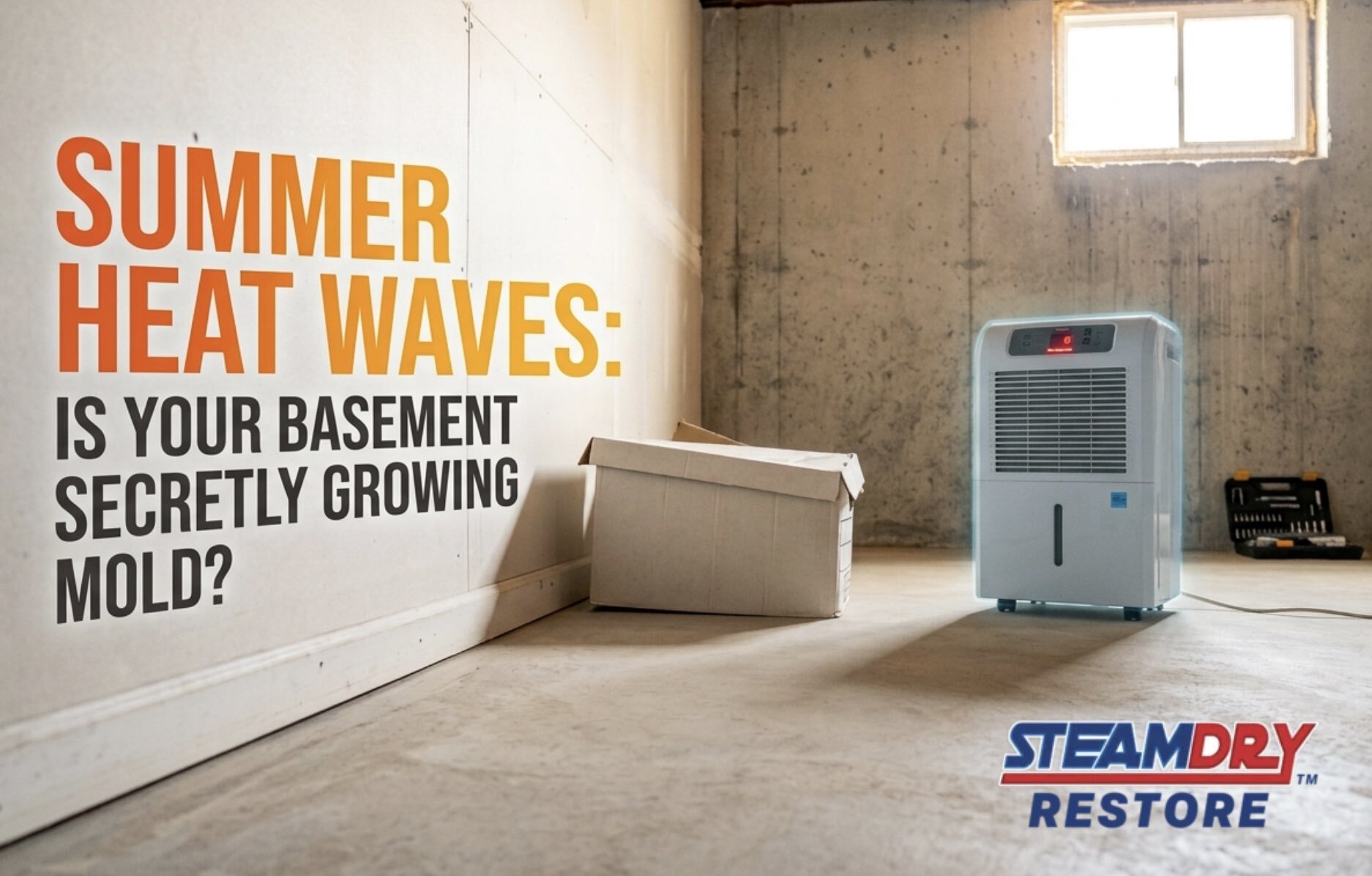
When the thermostat crosses 90 degrees in Southeast Wisconsin, our immediate instinct is to crank up the air conditioning and stay indoors. But while you are keeping cool upstairs, a quiet crisis could be developing right beneath your feet.
Extreme summer heat waves combined with our high regional humidity create the absolute perfect breeding ground for mold. Because mold can begin to colonize in as little as 24 to 48 hours, a hidden moisture issue can quickly escalate into a costly remediation project.
Here is why our current weather wave is putting local basements at risk, the warning signs you need to look for, and how to protect your property.
The “Sauna Effect”: Why 90-Degree Heat Sparks Basement Mold
Basement mold during a summer heatwave usually comes down to a simple scientific reaction: condensation.
Sub-surface basement walls stay relatively cool—usually hovering around 55 to 60 degrees—because they are insulated by the earth outside. When we experience 90-degree days with high relative humidity, that heavy, moisture-laden air sneaks into our homes through open doors, windows, and microscopic foundation cracks.
When that hot, humid air hits your cool basement walls and floors, it reaches its “dew point” and instantly turns into liquid water droplets. This creates a relentless layer of condensation across concrete, drywall, carpeting, and stored cardboard boxes—providing mold spores with the exact moisture and organic food source they need to thrive.
Warning Signs of Hidden Summer Mold
Mold doesn’t always show up as a visible black patch on the wall right away. Keep an eye (and nose) out for these subtle indicators:
- The “Summer Musty” Odor: If your basement suddenly smells earthy, damp, or musty when the weather gets hot, mold is actively growing somewhere out of sight.
- A Straining Dehumidifier: If your basement dehumidifier is running constantly, filling up multiple times a day, or failing to drop the humidity below 50%, the moisture load is too high.
- Peeling, Bubbling, or Discolored Baseboards: Condensation often pools at the base of walls first, causing paint to bubble or drywall to soften.
- Warped Cardboard Boxes: Check your basement storage. Damp, sagging boxes are a primary food source for mold.
3 Immediate Steps to Protect Your Home Right Now
- Keep Windows and Doors Securely Closed: It can be tempting to “air out” a damp basement on a summer evening, but letting that humid night air inside only fuels the condensation cycle. Rely on mechanical ventilation and AC instead.
- Maintain Indoor Humidity Below 50%: Run a properly sized dehumidifier continuously. If your unit doesn’t have a direct drain hose to a sump pump or floor drain, ensure it is emptied frequently so it never shuts off automatically when full.
- Pull Storage Away from External Walls: Keep furniture, plastic bins, and boxes at least a few inches away from perimeter concrete walls to allow proper airflow and prevent trapped moisture pockets.
When to Call the Professionals
If you discover a leak, experience a sudden sump pump failure during a summer storm, or notice a persistent musty smell that won’t go away, DIY cleaning sprays often aren’t enough. Scrubbing visible mold without proper containment can actually release millions of spores into your indoor air supply, spreading the issue to your HVAC system.
At Steam Dry Restore, we provide rapid-response emergency water extraction, structural drying, and professional mold remediation to keep your indoor air safe and your property protected.
Proudly Serving Our Southeast Wisconsin Communities
We live and work where you do. Our local restoration technicians are on call 24/7 to support homeowners and commercial property managers across the entire region, including:
- Waukesha County: Brookfield, Delafield, Hartland, Lisbon, Menomonee Falls, Mukwonago, Muskego, New Berlin, Oconomowoc, Pewaukee, Sussex, and Waukesha.
- Racine & Kenosha Counties: Burlington, Kenosha, and Racine.
- Milwaukee County: Franklin, Oak Creek, and West Allis.
- Walworth County: Delavan, East Troy, Elkhorn, Lake Geneva, and Whitewater.
- Washington & Ozaukee Counties: Grafton, Hartford, Jackson, Slinger, and West Bend.
- Jefferson & Dodge Counties: Fort Atkinson, Johnson Creek, Lake Mills, Waterloo, and Watertown.
- Rock County: Janesville.
Don’t let hidden moisture compromise your home this summer. If you suspect water damage or mold growth in your basement, contact the team at Steam Dry Restore today for a professional assessment.